Ask any legendary Hollywood cinematographer what separates an expensive Academy Award-winning motion picture from a cheap home camcorder recording, and they will give you a single-word answer: Lighting. The exact same law governs generative AI image synthesis. You can have the most detailed subject description, the latest diffusion model checkpoint, and pristine 85mm camera optics—but if your lighting prompt is simply "good lighting" or "studio lights", the neural network will default to a flat, uninspired, evenly-exposed render that screams artificial generation.
Lighting is emotional tone. Lighting is narrative storytelling. Lighting sculpts the planes of the human face, separates characters from cluttered backgrounds, and injects atmospheric depth that grabs the viewer's attention. In this handbook, we are breaking down seven masterclass cinematic lighting setups you can prompt in Google Gemini, Midjourney v6, and ChatGPT DALL-E, complete with copy-paste prompt formulas, Kelvin color temperature scales, and contrast ratio strategies.
Never let the AI guess where light originates. Always define three variables in your lighting tokens: Light Source Direction (e.g. 45-degree key light, overhead, high-rim), Light Quality (hard specular edge vs diffused octabox softbox), and Color Temperature (warm 2700K tungsten amber vs cool 6500K overcast daylight).
1. Rembrandt Lighting: The Renaissance Fine Art Standard
Named after the Dutch master painter Rembrandt van Rijn, this lighting setup is the timeless gold standard for fine art portraiture. In physical photography, it is achieved by placing a single key light approximately 45 degrees to the side and slightly above the subject's eye line.
The visual signature of authentic Rembrandt lighting is the luminous illuminated triangle of light on the shadowed cheek beneath the eye, with the remainder of that side falling into deep, sculpted shadow. It adds immediate psychological gravity, maturity, and dramatic presence to your characters. Check out our guide on Photorealistic 8K Portraits to see how to pair Rembrandt lighting with realistic skin pores.

Fine art studio portrait of a 42-year-old distinguished author, sharp contemplative expression, dark background with subtle painted texture. Masterful classic Rembrandt lighting setup with key light positioned at 45 degrees, casting a distinct illuminated triangle of light on the shadow cheek, deep velvety shadows, rich tonal range. Shot on Hasselblad H6D-100c, 100mm f/2.2 lens, muted color palette, painterly realism, museum gallery lighting quality --ar 16:9 --v 6.0
2. Cyberpunk & Neon Noir: High-Contrast Bi-Color Lighting
If you love futuristic, moody street photography—like our viral prompt The Neon Lens Cinematic Portrait—neon noir lighting is your weapon of choice. This style relies on complementary color theory, typically juxtaposing electric cyan/teal against magenta/neon pink.
The secret to avoiding muddy colors in AI neon generation is specifying wet reflective surfaces (such as rain-slicked asphalt, damp umbrellas, or chrome metal) and atmospheric moisture (like volumetric mist, steam, or ambient smog). These elements catch specular reflections, turning flat colors into dimensional light trails. Explore more examples in our Cinematic AI Prompts collection.
Cinematic full-body street photograph of a young man walking down a rain-soaked Tokyo alleyway at night, wearing a distressed black leather jacket, carrying a wet umbrella. High-contrast neon noir lighting, vibrant electric cyan and hot magenta neon signs casting colorful specular reflections on the wet asphalt, atmospheric steam rising from street vents, anamorphic horizontal lens flare, 35mm f/1.4 lens, ISO 800, blade runner aesthetic, gritty cinematic movie still --ar 16:9 --v 6.0
3. Golden Hour & Rim Light: Organic Warmth & Edge Separation
Golden hour (the final 45 minutes before sunset) produces the most flattering, natural light on Earth. However, beginner prompts often end up with an orange haze washed out across the entire image. To control golden hour in generative AI, introduce rim lighting (also called edge or kicker light).
By prompting the low-angle sun directly behind your subject, the AI renders a brilliant golden halo tracing the silhouette of the hair and shoulders, separating your subject cleanly from dark background foliage or distant mountain ridges. Check out our scenic prompt Classic Car Mountain Dusk Lifestyle for a practical demonstration.
4. Volumetric Light & God Rays (The Tyndall Effect)
Have you ever seen visible shafts of sunlight streaming through cathedral stained glass windows or dense forest canopies? In physics, this phenomenon is known as the Tyndall effect. In cinematography, it is called volumetric lighting.
To make AI models render visible light beams, you must prompt a suspended atmospheric medium: "morning haze", "dust motes suspended in air", "misty forest air", or "volumetric god rays breaking through windows". Without a scattering medium, light remains invisible until it hits an opaque surface!
5. The Kelvin Color Temperature Scale for AI Prompters
Professional lighting technicians measure color temperature on the Kelvin (K) scale. By injecting exact Kelvin numbers into your prompt, you eliminate vague color terms and command the exact psychological temperature of your scene:
| Kelvin Value | Color Appearance | Prompt Keywords & Cinematic Mood |
|---|---|---|
| 1800K – 2200K | Deep warm amber / orange | "Candlelight, flickering fireplace, vintage gas lamp glow" – Intimate, romantic, cozy. |
| 2700K – 3200K | Warm incandescent yellow | "Warm tungsten interior lighting, domestic lamp glow" – Nostalgic, homelike, relaxed. |
| 4500K – 5000K | Golden neutral white | "Golden hour late afternoon sun, diffused sunlight" – Natural, vibrant, flattering. |
| 5600K – 6000K | Crisp daylight white | "Direct midday daylight, balanced 5600K studio strobe" – Clean, clinical, editorial. |
| 7500K – 9000K | Cool icy blue / overcast | "Misty overcast twilight, Scandinavian winter sky, pre-dawn blue hour" – Melancholic, mystery. |
6. High-Key vs Low-Key: Directing Contrast Ratios
Beyond color, you must control the contrast ratio between highlights and shadows:
- High-Key Lighting: Dominated by bright whites, light tones, and minimal shadows. Perfect for clean beauty product shoots, cheerful lifestyle fashion, and optimistic corporate branding. Use prompts like: "high-key studio lighting, luminous white backdrop, shadowless soft diffused beauty dish, even exposure".
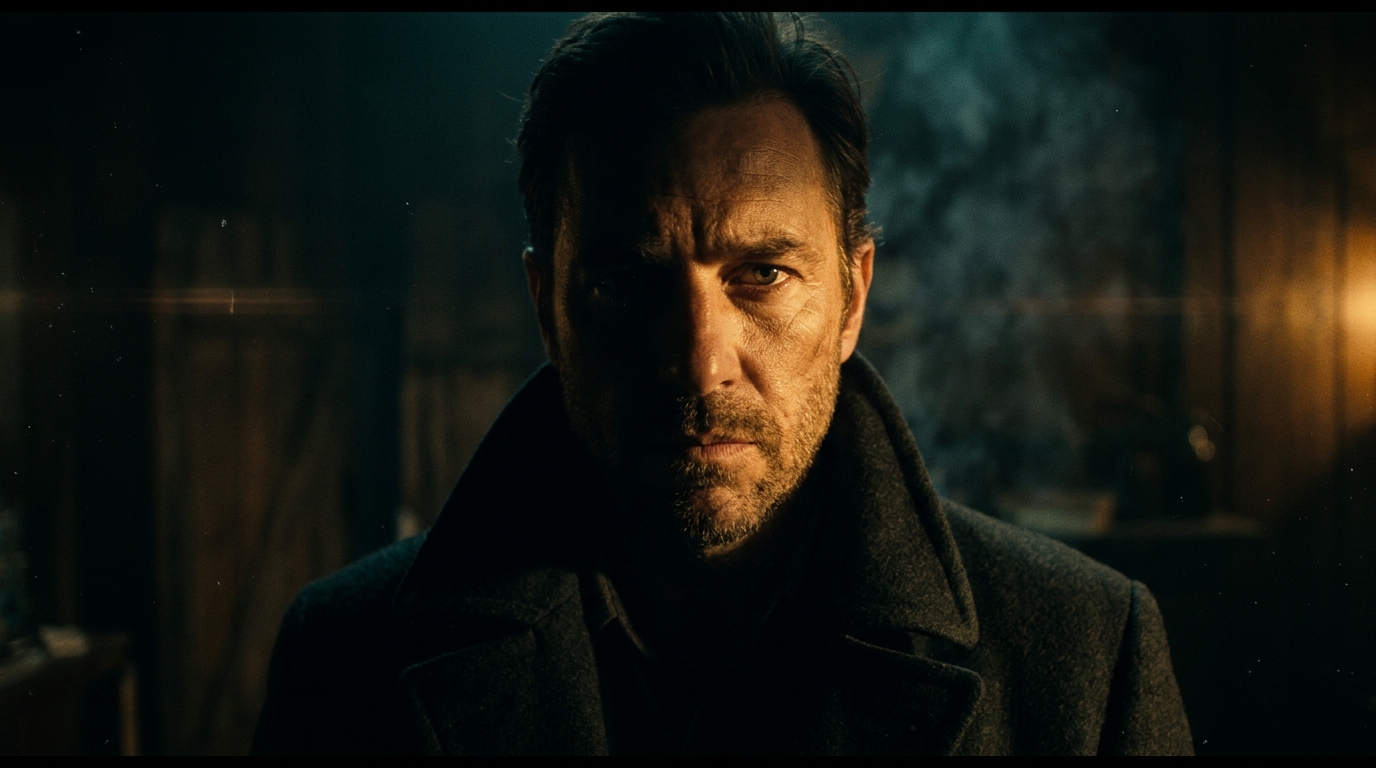
- Low-Key Lighting: Dominated by deep blacks, rich shadows, and selective pinpoint illumination. Ideal for psychological thrillers, film noir, heroic character reveals, and dramatic portraits. Use prompts like: "low-key chiaroscuro lighting, deep impenetrable black background, single hard edge rim light, dramatic 8:1 contrast ratio".
💡 Pro Cinematographer Vocabulary Cheat Sheet
- Chiaroscuro: Strong, dramatic contrast between light and dark, creating bold sculptural three-dimensionality.
- Rim Light / Kicker: Light placed behind or to the side of the subject that creates a bright outline along edges.
- Diffused Softbox: Light passed through sheer fabric that creates ultra-soft, gentle shadow transitions with zero harsh lines.
- Specular Highlights: The bright, pinpoint reflections of light sources on wet, glossy, or metallic surfaces.
- Bounce Fill: Gentle secondary illumination reflected from a surface to soften harsh shadows under the chin and nose.
7. Before & After: The Evolution of a Cinematic Lighting Prompt
Let’s examine the side-by-side visual difference between amateur prompting and pro lighting prompting:
A woman standing in an alley at night, good lighting, beautiful, realistic photo, highly detailed, 8k
Result: Muddy shadows, flat flash-like lighting, plastic skin, dull colors.A woman standing in an alley, cinematic chiaroscuro, single overhead sodium vapor street lamp casting 3200K amber key light, subtle cyan neon rim light from shop sign, wet cobblestones with specular highlights, shallow depth of field, 50mm f/1.8 lens --ar 16:9
Result: Deep dramatic contrast, dimensional facial sculpting, atmospheric movie quality.Conclusion: Take Full Command of the Frame
Mastering light is the single fastest way to transform your AI creations from generic stock images into museum-worthy photographic art. Pair these lighting setups with the optical camera techniques in our 8K Portrait Masterclass to achieve unbelievable results. Browse our Cinematic AI Prompts today to copy tested lighting prompts with a single click!