Here is a thought experiment. Take this prompt: "a woman standing in the rain on a city street at night, neon lights, cinematic". Now run that exact prompt with three different camera angles: eye level, low angle looking up, and bird's eye looking straight down. You will get three completely different images — different emotions, different power dynamics, different stories — from the exact same words.
That is how powerful camera angle is in an AI image prompt. It is one of the most overlooked variables by beginners, and one of the most used variables by creators whose images consistently look professional and intentional.
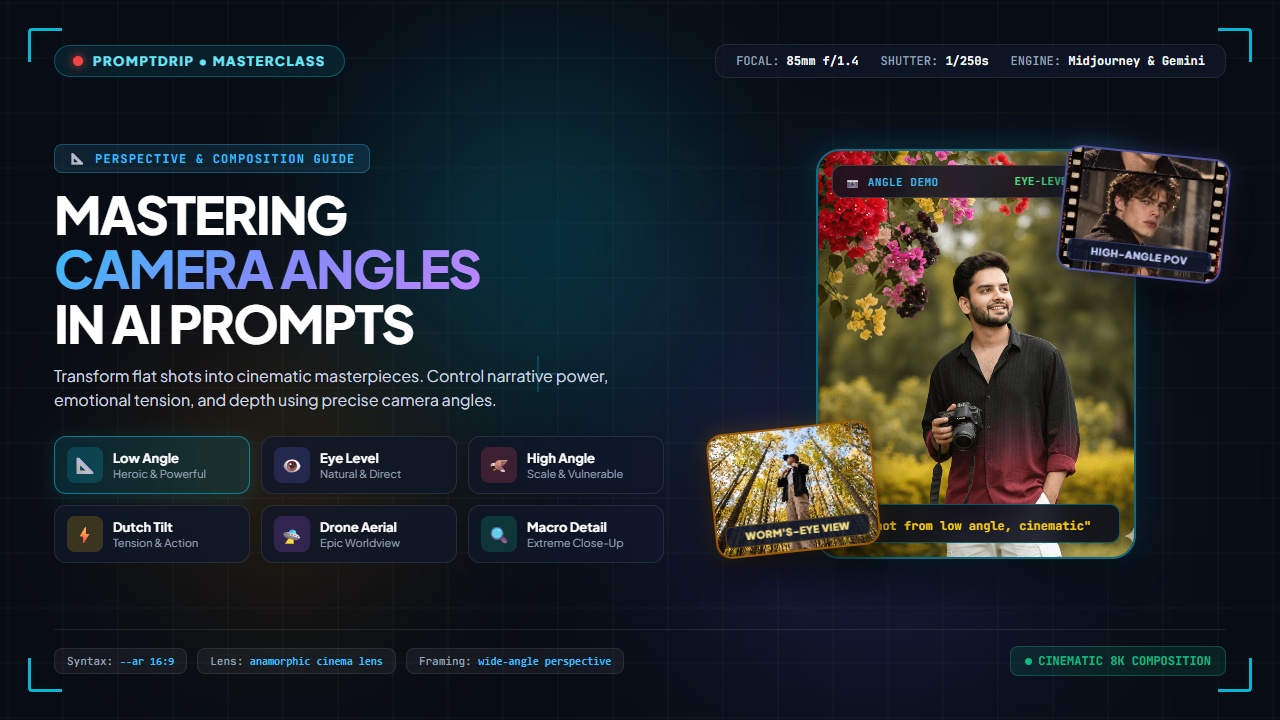
This guide covers every major camera angle — what it does, when to use it, and the exact keywords to put in your prompt to make it happen.
Why Camera Angle Changes Everything
Before we get into the angles themselves, it helps to understand what camera placement actually controls in an image. When you specify an angle, you are not just changing where the camera is — you are changing:
- Power dynamics — who looks dominant or vulnerable in the frame
- Emotional tone — intimacy, grandeur, tension, playfulness
- Spatial storytelling — how much context and environment is visible
- Composition — where the subject falls in the frame, what surrounds them
- Visual drama — how cinematic or ordinary the shot feels
A real photographer makes conscious decisions about angle for every single shot. When you write an AI prompt, you are the photographer. Specifying the angle is part of giving clear direction.
Camera Angle Position Map
CENTER
The Complete Camera Angle Dictionary for AI Prompts
1. Eye Level — The Natural Default
What it is: The camera is positioned at the subject's eye height, shooting straight ahead. This is the most natural perspective — what you see when you look at someone face to face.
What it communicates: Equality, naturalness, approachability, realism. This is the angle of connection — it does not make the subject look powerful or weak, just present.
Best for: Portrait photography, lifestyle shots, editorial images, conversational scenes, documentary-style imagery.
📷 Eye Level Prompt Example
"Eye level portrait of a 28-year-old South Asian woman, direct gaze into camera, natural confident expression, wearing a deep blue silk top, studio softbox lighting, 85mm lens f/1.8, clean light background, editorial photography style, photorealistic, 8K"
2. Low Angle (Worm's Eye View) — Power and Dominance
What it is: Camera is placed below the subject, shooting upward. The subject towers above the viewer. The sky or ceiling is often visible in the background.
What it communicates: Power, authority, dominance, strength, heroism, intimidation. When you look up at something, your brain registers it as bigger and more powerful than you. This is why action movie posters almost always use low angles for the hero.
Best for: Warriors, heroes, leaders, fashion shots that convey confidence, architectural shots, dramatic character art.
📷 Low Angle Prompt Example
"Low angle shot looking upward at a powerful Indian warrior woman in traditional armor and jewels, spear in hand, dramatic overcast sky behind her, sunlight breaking through storm clouds, dynamic heroic pose, cinematic composition, epic mood, Unreal Engine render quality, 8K ultra detailed"
💡 Worm's Eye vs Low Angle
There is a difference: "low angle" is slightly below — still natural. "Worm's eye view" is extreme — camera is at floor level looking all the way up. Use worm's eye for maximum dramatic effect, low angle for confident character shots.
3. High Angle — Vulnerability and Context
What it is: Camera is placed above the subject, shooting downward. The subject looks smaller in the frame, and more of the surrounding environment is visible.
What it communicates: Vulnerability, smallness, being watched, a sense of the larger world around the subject. It can also feel protective or overhead — like seeing a character in the context of their world.
📷 High Angle Prompt Example
"High angle shot looking down at a woman sitting alone on a wooden bench in an empty park, autumn leaves scattered around her, hands folded in her lap, looking down, melancholic mood, overcast natural light, 35mm wide lens, cinematic color grade, documentary photography style, ultra detailed"
4. Bird's Eye View — Pure Overhead
What it is: Camera is directly overhead, pointing straight down at 90 degrees. The subject is seen completely from above. There is no sense of depth — the ground becomes the background.
What it communicates: Pattern, arrangement, design, intimacy with objects, a god-like perspective. It strips away the usual perspective and makes everyday scenes feel abstract or artistic.
📷 Bird's Eye View Prompt Example
"Bird's eye view, directly overhead shot looking straight down at a woman lying on a bed of rose petals, wearing a white dress, arms spread out, eyes closed, serene expression, soft natural light from above, dreamy and ethereal mood, fashion editorial style, top-down flat lay composition, 8K photorealistic"
5. Close-Up and Extreme Close-Up — Detail and Emotion
What it is: Camera is very close to the subject, filling the frame with just the face, hands, eyes, or a specific detail. An extreme close-up (ECU) isolates a single feature — just the eyes, just the lips, just the texture of fabric.
📷 Extreme Close-Up Prompt Example
"Extreme close-up of a woman's eye, South Asian appearance, golden eyeshadow with tiny glitter particles, long curved lashes with dewdrops, the iris showing a reflection of a city at night, macro photography, 100mm macro lens, studio ring flash, ultra-sharp detail, skin pore texture visible, Hasselblad medium format quality, 8K"
6. Wide Shot and Establishing Shot — Context and Scale
What it is: Camera is far from the subject, showing the full body and a significant portion of the surrounding environment. An establishing shot shows even more — the entire location, often with a very small or absent human figure.
📷 Wide Establishing Shot Prompt Example
"Wide establishing shot of a lone monk in saffron robes walking across a vast ancient stone bridge over a mountain river in the Himalayas, snow-capped peaks rising behind, morning mist in the valley below, scale showing the human as tiny against the landscape, 24mm ultra wide lens, f/11, National Geographic documentary style, 4K ultra detailed, golden hour light"
7. Over the Shoulder (OTS) — Conversation and Perspective
What it is: Camera is positioned behind and slightly to the side of one subject, framing them from behind while showing what they are looking at in front of them.
📷 Over-the-Shoulder Prompt Example
"Over the shoulder shot, camera behind a woman looking out at a rainy Mumbai street from a cafe window, her reflection faintly visible in the glass, street lights reflecting off wet roads outside, bokeh of red and yellow lights, moody and cinematic, 50mm lens, shallow depth of field, Kodak Portra 800 film look, documentary style"
8. Dutch Angle (Tilted Camera) — Tension and Unease
What it is: Camera is rotated on its axis so the horizon line is diagonal rather than straight. Also called a canted angle or oblique angle.
What it communicates: Psychological tension, disorientation, something is wrong, instability, conflict, mystery.
📷 Dutch Angle Prompt Example
"Dutch angle tilted shot of a detective in a dark rain-soaked alley at night, coat collar turned up, one neon sign casting a red light across their face, shadows and pools of light, cinematic noir style, 35mm lens, strong film grain, Hitchcock thriller composition, dramatic and tense mood, photorealistic"
Emotion → Angle: Quick Visual Reference
Not sure which angle to pick? Start from the feeling you want and work backwards:
The Full Camera Angle Reference Table
| Angle Name | Prompt Keyword | Mood / Feel | Best Use Case |
|---|---|---|---|
| Eye Level | eye level shot | Natural, equal, relatable | Portraits, lifestyle, editorial |
| Low Angle | low angle shot, shot from below | Powerful, dominant, heroic | Warriors, heroes, confident portraits |
| Worm's Eye | worm's eye view, extreme low angle | Extreme power, towering, epic | Dramatic character art, architecture |
| High Angle | high angle shot, shot from above | Vulnerable, small, observed | Emotional scenes, storytelling |
| Bird's Eye | bird's eye view, top-down shot, overhead view | Abstract, patterned, god-like | Flat lay, aerial, overhead portraits |
| Close-Up | close-up shot, tight shot | Emotional, intense, intimate | Faces, expressions, beauty |
| Extreme Close-Up | extreme close-up, macro shot | Hyper-detail, texture, intensity | Eyes, skin, jewelry, product texture |
| Wide Shot | wide shot, full body shot, long shot | Spacious, environmental, adventurous | Travel, architecture, environment |
| Over the Shoulder | over the shoulder shot, OTS shot | Perspective, narrative, witnessing | Storytelling scenes, two subjects |
| Dutch Angle | dutch angle, tilted camera, canted angle | Tension, unease, disorientation | Thrillers, horror, action, editorial |
Camera Distance: Shot Sizes That Pair With Your Angle
Angle and shot size (distance) work together. Specify both for maximum control over composition:
| Shot Size | What Is in Frame | Prompt Keyword |
|---|---|---|
| Extreme Wide | Vast landscape, subject very small or absent | extreme wide shot, aerial shot |
| Wide / Full Shot | Full body + significant environment | wide shot, full body shot |
| Medium Wide | Full body with some environment | medium wide shot, cowboy shot |
| Medium Shot | Waist up | medium shot, waist-up shot |
| Medium Close-Up | Chest and shoulders up | medium close-up, chest-up shot |
| Close-Up | Face and neck only | close-up, tight shot, face shot |
| Extreme Close-Up | Single feature — eye, lip, hand | extreme close-up, macro, ECU |
Combining Angle + Distance + Lens — 3 Full Examples
🎬 Example 1 — Heroic Action Character
"Low angle worm's eye view, full body wide shot, 24mm ultra wide angle lens — a female warrior in futuristic black armor standing on a cliff edge, storm clouds breaking behind her, lightning on the horizon, dramatic rim lighting, epic cinematic mood, Unreal Engine 5 quality render, 8K ultra detailed"
🎬 Example 2 — Intimate Emotional Portrait
"Eye level close-up, 85mm portrait lens f/1.4 — close portrait of an elderly Indian woman, deep wrinkles, warm kind eyes filled with emotion, thin gold nose ring, white hair with a vermillion bindi, soft afternoon window light on her face, documentary photography style, Kodak Portra 400 film, photorealistic, ultra high detail"
🎬 Example 3 — Environmental Scale Shot
"Bird's eye view aerial establishing shot, 16mm extreme wide angle — a lone fisherman on a traditional wooden boat in the middle of a glassy turquoise Kerala backwater, surrounded by green palm-lined banks, perfect reflection of the sky in the water, golden hour, drone photography style, National Geographic quality, 4K ultra detailed"
The One Rule That Ties It All Together
Here is the single most important thing to take away from this guide: every element of your prompt should serve the same story.
If you want a powerful, dominant character — use a low angle, dramatic lighting, a wide lens, and epic background. If you want an intimate, emotional moment — use eye level or high angle, soft close-up framing, warm natural light, and shallow depth of field. When angle, lighting, lens, and mood all point in the same direction, the image will look intentional and professional. When they contradict each other, the AI produces something confused and flat.
The creators who consistently generate jaw-dropping images are not using more keywords — they are using more coherent keywords. Every word in your prompt should agree with every other word.
Now that you understand angles, the next step is combining them with the other five elements of a great prompt. Read the full breakdown in our guide on how to get the best AI image output, and explore our cinematic lighting handbook to pair perfect angles with perfect light. If you want ready-made prompts that already use these techniques, browse by category — portraits, cinematic, and fashion.